Sichuan
Geographical Location and Provincial Layout

Sichuan Province lies in the hinterland of southwestern China, in the upper reaches of the Yangtze River, between longitudes 97°21′ and 108°33′ E and latitudes 26°03′ and 34°19′ N. The province’s terrain is high in the west and low in the east. The west consists of the eastern margin of the Qinghai‑Tibet Plateau and the northern section of the Hengduan Mountains; the east is the well‑known Sichuan Basin and its surrounding mountainous areas. The basin floor, at an elevation of 250–750 metres, has been built up by alluvial deposits from the Min, Tuo, Fu, Jialing, and other rivers. It has fertile soil and a dense river network, and is the most complete in form and lowest in latitude among China’s four major basins. The western plateau averages over 3,000 metres above sea level, with the main peak of Mount Gongga reaching 7,556 metres—the province’s highest point. The vertical climate zones are fully developed, with glaciers, meadows, and forests interwoven. The Yangtze River flows from west to east across the province; its upper main stream, the Jinsha River, rushes down along the Sichuan‑Yunnan border, joins the Min River at Yibin, and from there is formally named the Yangtze, then receives the Tuo, Jialing, and other tributaries, forming a centripetal drainage system that gives Sichuan the reputation of a “province of a thousand rivers.”
Sichuan covers 486,000 square kilometres, ranking fifth in China, and has 18 prefecture‑level cities and 3 autonomous prefectures. At the end of 2023, its permanent population was about 83.7 million, making it China’s fourth most populous province. Administratively, Sichuan exhibits a clear dual structure of “basin plus plateau.” The provincial capital, Chengdu, lies in the western part of the basin on the Min River alluvial fan. It is the political, economic, and cultural centre of the province, one of China’s nine national central cities, and the driving force behind the development of the province and even the west. In recent years, a pattern of sub‑centres has accelerated its formation. Mianyang, as China’s only Science and Technology City, serves as the innovation engine of northern Sichuan. Yibin, situated at the head of the Yangtze, leverages its liquor industry and new lithium‑battery materials to lead the southern Sichuan economic zone. Nanchong, with its demographic and locational advantages, supports the revitalisation of northeastern Sichuan. Among the specialised cities, Leshan is famous for the UNESCO World Heritage mixed site of the Leshan Giant Buddha and Mount Emei; Zigong is renowned for its thousand‑year‑old salt industry and dinosaur fossils; and the three prefectures—Ganzi, Aba, and Liangshan—bear the rich ethnic cultures and magnificent plateau scenery that together form Sichuan’s three‑dimensional and diverse provincial economic‑cultural landscape.
Historical Context

Human activity in Sichuan can be traced back to the Wushan Man (in present‑day Chongqing municipality) about 2 million years ago, but its history as a centre of civilisation begins with the Baodun culture in the late Neolithic. Around 1600 BCE, the ancient Shu kingdom, represented by the Sanxingdui site, flourished on the Chengdu Plain. The bronze sacred trees, protruding‑eye masks, and other treasures unearthed there reveal a brilliant bronze civilisation markedly different from that of the Central Plains. In 316 BCE, King Huiwen of Qin sent Sima Cuo to destroy Ba and Shu, establishing Shu Commandery and formally incorporating Sichuan into the Central Plains empire. Subsequently, Li Bing and his son built the Dujiangyan irrigation system, diverting the Min River to water the Chengdu Plain, turning the Shu region into a “land of abundance” where “droughts and floods were controlled, and famine was unknown.” During the Qin and Han dynasties, Chengdu was ranked among the “Five Capitals” alongside Luoyang and Handan, and Shu brocade and lacquerware were exported as far as the Western Regions, making it the starting point of the Southern Silk Road.
At the end of the Han and during the Three Kingdoms period, Liu Bei established the Shu Han dynasty with Chengdu as its capital. Zhuge Liang’s administration left behind sites such as the Wuhou Shrine, and the culture of the Three Kingdoms became an important strand of Sichuan’s history. In the Tang dynasty, Sichuan enjoyed a second golden age, with the saying “Yangzhou first, Yizhou (Chengdu) second”—Chengdu was the second largest city in the empire after Yangzhou. The Du Fu Thatched Cottage, Xue Tao’s writing paper, and Qiong kiln porcelain all date from this period. In the Song dynasty, Chengdu saw the birth of the world’s earliest paper currency, jiaozi; commercial prosperity gave rise to the “Twelve Monthly Markets,” and a galaxy of Shu scholars emerged, including Wen Tong and Su Shi. At the end of the Yuan and the beginning of the Ming, and again at the end of the Ming and the beginning of the Qing, Sichuan suffered repeated wars—especially Zhang Xianzhong’s occupation of Shu and the Qing army’s entry, which drastically reduced the population. The subsequent “Huguang Fills Sichuan” mass migration reshaped the demographic structure, and traces of immigrant culture can still be found in Sichuan’s dialects and folk customs today. In the late Qing, the Sichuan Railway Protection Movement directly triggered the 1911 Revolution, dealing a critical blow to the Qing regime. During the War of Resistance against Japan, Chongqing (then part of Sichuan) served as the wartime capital, and Sichuan became the great rear area, hosting a large number of factories, schools, and people, making tremendous sacrifices and contributions to the national salvation effort.
Historical sites are spread throughout the province. The Dujiangyan irrigation project, still in operation after 2,000 years, is a living monument. The Sanxingdui and Jinsha sites continue to reshape our understanding of ancient Shu civilisation. The Wuhou Shrine and Du Fu Thatched Cottage preserve the memory of the Three Kingdoms and Tang poetry. The Leshan Giant Buddha and the temple complexes of Mount Emei bear witness to the heyday of Buddhism. The ancient city of Langzhong preserves its Ming‑Qing layout and is a living specimen of feng shui culture. These historical sites, like beads on a string, link Sichuan’s thousands of years of history from ancient Shu to modern times.
Cultural Heritage

Sichuan culture is a product of the interweaving of the ancient Shu civilisation of the upper Yangtze and the immigrant cultures of successive dynasties, embodying a spirit of inclusiveness, humour, and resilience. In terms of dialect, Sichuanese belongs to the Southwestern Mandarin group, with Chengdu and Chongqing (now a separate municipality) dialects as its representatives, and has a high degree of internal consistency. Its phonology is simple—no retroflex initials, no distinction between front and back nasal finals—and preserves a distinctive tonal pattern in which the entering tone merges into the rising tone. The highly witty yanzi’er (pithy sayings) and allegorical two‑part sayings give the language a vivid vitality. In folk traditions, the Wuhou Shrine Temple Fair during the Spring Festival and the Zigong International Dinosaur Lantern Festival are celebrated nationwide; customs such as “visiting the auspicious deities” in the western Sichuan plains and the Hakka water‑dragon dance are still practiced. Marriage and funeral rites, influenced by the fusion of Confucianism, Buddhism, and Daoism, emphasise the social exchange of “red and white occasions” with elaborate etiquette. Popular religious belief is diverse; the worship of Wenchang (at Zitong) and Chuanzhu (the River God, Li Bing and his son) are highly region‑specific, while the mountain‑circuit festivals of the Tibetans, the Torch Festival of the Yi, and the Qiang New Year add colour to Sichuan.
The arts are spectacular. Sichuan opera is the province’s most important local opera genre, combining five tune systems—high‑pitch, Kunqu, huqin, tanxi, and dengxi—and is famous for its virtuosic stunts of face‑changing, fire‑breathing, and rolling lanterns. It was inscribed on the national intangible cultural heritage list in 2006. Shu embroidery, together with Suzhou, Hunan, and Guangdong embroidery, is one of China’s “Four Great Embroideries,” with over 100 stitching techniques, using soft satin and coloured silk to depict flowers, birds, fish, and insects with a lustrous sheen. Sichuan yangqin (dulcimer), qingyin (clear‑tune singing), and zhuqin (bamboo‑stringed instrument) are refined and popular arts; Mianzhu New Year paintings, known for their colouring, are as famous as Yangliuqing in Tianjin and Weifang in Shandong. In crafts, Chengdu lacquerware, Yingjing sand pottery, Zigong Gong fan, and Qingshen bamboo weaving are all intangible cultural heritage treasures. The province has 7 UNESCO intangible cultural heritage items and 153 national‑level representative intangible cultural heritage projects, including the Epic of King Gesar, the Qiang New Year, Shu brocade weaving, and Luzhou Laojiao liquor‑making techniques—covering oral traditions, performing arts, social practices, and traditional crafts, making Sichuan a major province of intangible cultural heritage.
Architecture and Urban Landscape

Sichuan’s traditional architecture blends the Central Plains timber‑frame system with local climate and materials to form a distinctive style. In the basin, where it is hot and rainy, dwellings generally use a column‑and‑tie‑beam wooden frame, with walls of bamboo‑woven mud or wooden planks, and deep overhanging eaves that form continuous arcades along the streets, providing shade and shelter from rain while creating grey spaces for neighbourly interaction. The Wide and Narrow Alleys in Chengdu and the ancient town of Yuantong in Chongzhou are typical surviving examples. The western Sichuan linpan is a unique farming settlement pattern on the Chengdu Plain, where farmhouses are hidden among bamboo groves and trees, interwoven with courtyards, ditches, and fields, forming a living heritage that integrates ecology, production, and daily life. In the hilly areas of eastern Sichuan, stone construction is common; the flagstone streets and stilted houses of Enyang Ancient Town in Bazhong skillfully adapt to the terrain. On the northwestern plateau, the Tibetan and Qiang stone towers and villages, built of rubble stone and rising tens of metres, combine defence and dwelling; Taoping Qiang Village and the Danba Tibetan village clusters are outstanding representatives. The Yi people’s adobe‑and‑timber houses and the Mosuo people’s log cabins reflect the diverse wisdom of mountain architecture.
In modern and contemporary architecture, after Chongqing was opened as a treaty port at the end of the 19th century, Western architectural styles spread up the river. In Chengdu’s Huaxiba area, a group of missionary university buildings combining Chinese and Western elements—with grey bricks, grey tiles, and hip‑and‑gable roofs—appeared. During the War of Resistance, the large‑scale relocation of factories and institutions from the coast produced a large number of simple, functionalist industrial and public buildings. The contemporary urban landscape of Sichuan shows multi‑layered superimposition: in Chengdu’s Tianfu Square–Chunxi Road commercial district, modern skyscrapers stand side by side with the thousand‑year‑old Daci Temple; Taikoo Li perfectly blends traditional western Sichuan courtyards with contemporary commerce. In terms of urban fabric, Chengdu retains the historical pattern of “two rivers embracing the city and three cities overlapping.” Mianyang, Yibin, and other cities have grown in clusters along their rivers. Distinctive neighbourhoods such as Tangba Street and Eastern Suburb Memory (an industrial‑site renovation) in Chengdu, and the Zigong Chinese Lantern World vividly record the evolution of Sichuan’s urban space from history to the future.
Culinary Culture
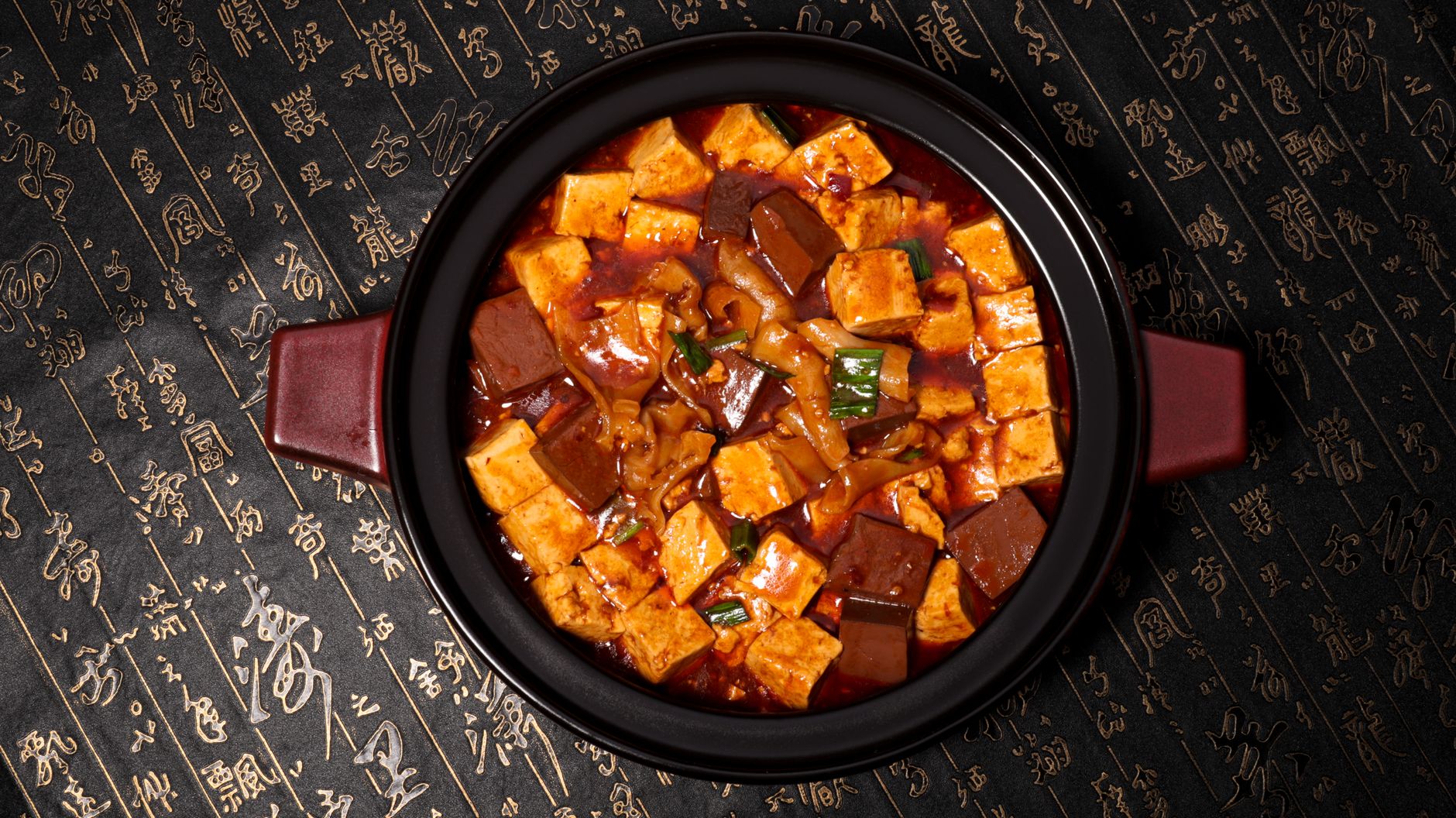
Sichuan cuisine is one of China’s four great culinary traditions, renowned for “one dish, one style; a hundred dishes, a hundred flavours.” Its soul lies in the infinite variety of seasoning. The Sichuan Basin is rich in produce and has a humid climate; local food culture values “fine flavours and a love of pungency.” After chillies were introduced in the early Qing, they combined with native Sichuan pepper to create the unique “numbing‑spicy” flavour profile. Sichuan cuisine comprises branches such as Chengdu official cuisine, Chongqing Jianghu cuisine, Zigong salt‑gang cuisine, and the Dahe and Xiaohe sub‑styles. It is meticulous in its flavour distinctions: 24 official flavour types—including fish‑fragrant, strange‑flavour, peppery‑numbing, red‑oil, home‑style, and garlic‑paste—are the most numerous of any Chinese regional cuisine. Among the classic dishes, Mapo Tofu is cooked with minced beef and Pixian doubanjiang, finished with a sprinkle of Sichuan pepper powder; it delivers a combination of hot, spicy, numbing, fresh, fragrant, tender, and crisp sensations in one mouthful, and tells the story of Chen Mapo, who ran a restaurant by Wanfu Bridge in Chengdu during the Qing dynasty. Kung Pao Chicken, created by the chef of Ding Baozhen, the Qing governor of Sichuan, has a sweet‑sour‑slightly‑spicy “lychee” flavour with crisp peanuts, and is now known worldwide. Twice‑Cooked Pork is hailed as the “first dish of Sichuan cuisine”—pork belly, boiled then sliced and stir‑fried with garlic sprouts and Pixian bean paste until glossy red, is the taste of home in the hearts of Sichuanese. Among famous snacks, Chengdu Dandan Noodles, Leshan Bobo Chicken, Yibin Burning Noodles, and Nanchong Chuanbei Liangfen (cold starch jelly) each have their own devoted following.
Sichuan food customs place great importance on seasonality and social warmth. In spring, people eat stir‑fried Chinese toon shoots with eggs; summer nights are for beer and cold dishes; in autumn and winter, mutton soup and hotpot are at their peak. Hotpot, with its beef‑fat red‑oil base, features tripe, goose intestine, and aorta in a nine‑grid pot, cooked with the “seven up, eight down” rhythm. The convivial scene of sharing a hotpot around the table perfectly captures the outgoing, hospitable, and bold character of the Sichuanese. Tea‑house culture is an extension of dining: bamboo chairs, covered bowls, long‑spouted teapot kung fu tea art, and leisurely longmenzhen (gossip) create a unique public space of ease and relaxation.
Modern and Contemporary Development

Sichuan’s modern transformation began with the opening of Chongqing as a treaty port in 1891, when Western goods and capital poured up the Yangtze, stimulating the emergence of national industry and commerce. During the War of Resistance, a large number of factories and schools moved inland from the coast and central China, making Sichuan briefly the country’s industrial and cultural centre. In Chongqing, Chengdu, Yibin, Luzhou, and elsewhere, a modern industrial system based on munitions, textiles, and chemicals was initially established. During the “Third Front” construction period (1960s–1970s), the state placed a large number of defence, electronics, machinery, and aerospace projects in Sichuan. Deyang became a heavy‑equipment manufacturing base; Mianyang laid the foundation for a defence‑research and electronics industry cluster; Panzhihua, with its vanadium‑titanium steel, emerged as a new steel city. These laid a solid industrial foundation for Sichuan.
Since reform and opening up, Sichuan has gradually shifted from a planned‑economy bastion to an open frontier. After Chongqing became a separate municipality in 1997, Sichuan reshaped its provincial economic landscape and strengthened Chengdu’s core competitiveness. The Chengdu High‑Tech Zone and Tianfu New Area have successively risen, with the total output of electronic information, biomedicine, and automobile manufacturing ranking among the top in the country. Giants such as Intel, BOE, and Volvo have settled in; more than half of the world’s iPads and a large number of chips are assembled and tested here. At the same time, the division of labour among the province’s cities has become clearer: Chengdu focuses on next‑generation information technology and high‑end services; Mianyang specialises in defence electronics and nuclear technology applications; Deyang strengthens equipment manufacturing, while Yibin strengthens new materials and the liquor industry; Nanchong and Dazhou develop automobiles and energy chemicals in clusters; the Panxi economic zone is deep in vanadium‑titanium and sun‑health industries. Today, Sichuan is positioned as an inland strategic highland for opening up and a western economic centre, deeply integrated into the Belt and Road Initiative, the Yangtze Economic Belt, and the Chengdu‑Chongqing economic circle. Chengdu is transforming from an inland city into a pan‑European‑Asian international gateway hub.
Transportation and Travel

Sichuan is a transport hub in southwestern China. The roads of Shu were notoriously difficult in ancient times, but today a three‑dimensional network of railways, highways, waterways, and aviation has been completed. The main railway trunk lines—Baoji‑Chengdu, Chengdu‑Kunming, Chengdu‑Chongqing, Dazhou‑Chengdu, Xiangfan‑Chongqing, Lanzhou‑Chongqing, Xi’an‑Chengdu, Chengdu‑Guiyang, and Chengdu‑Zigong‑Yibin—converge in Chengdu. The Xi’an‑Chengdu high‑speed railway reduces travel time between Chengdu and Xi’an to 3 hours; the Chengdu‑Guiyang high‑speed rail connects Yunnan and Guizhou; the under‑construction Chengdu‑Dazhou‑Wanzhou high‑speed rail will open an eastward corridor. The Chengdu‑Ya’an section of the Sichuan‑Tibet railway is already open and will eventually extend to Lhasa. The province’s railway operating mileage exceeds 6,000 kilometres, of which about 1,500 kilometres are high‑speed. The expressway network has surpassed 10,000 kilometres in total mileage, ranking among the top in the country. National arteries such as Beijing‑Kunming, Shanghai‑Chengdu, Xiamen‑Chengdu, and Baotou‑Maoming pass through the province; the super‑engineered twin‑spiral tunnels of the Ya’an‑Xichang expressway overcome the natural barriers of the Hengduan Mountains. Chengdu Shuangliu International Airport and Tianfu International Airport form a dual‑hub system, operating more than 140 international (and regional) routes to Europe, the Americas, and Oceania, with annual passenger throughput exceeding 70 million—making it the largest aviation gateway in central and western China. Regional airports in Mianyang, Luzhou, Yibin, Nanchong, and others cover all economic zones.
The travel experience within the province is uniquely appealing. The “1‑hour commuter circle” between Chengdu and Chongqing has been achieved with the high‑frequency, bus‑style operation of intercity high‑speed trains. From Chengdu, the Chengdu‑Dujiangyan fast railway reaches Dujiangyan and Mount Qingcheng within one hour; the Chengdu‑Mianyang‑Leshan intercity railway runs north‑south through the basin, putting Leshan and Mount Emei within easy reach. Self‑driving in western Sichuan is a world‑class landscape journey—National Highway 318 (the Sichuan‑Tibet highway), National Highway 317 (the northern Sichuan‑Tibet route), National Highway 213 (Langchuan Highway), and Provincial Highway 434 (Ya’an‑Kangding Expressway) pass through snow mountains, grasslands, and canyons. The Yangtze River waterway downstream of Yibin is navigable by thousand‑tonne vessels; Luzhou and Yibin ports are Sichuan’s gateways to the sea.
Travel Tips
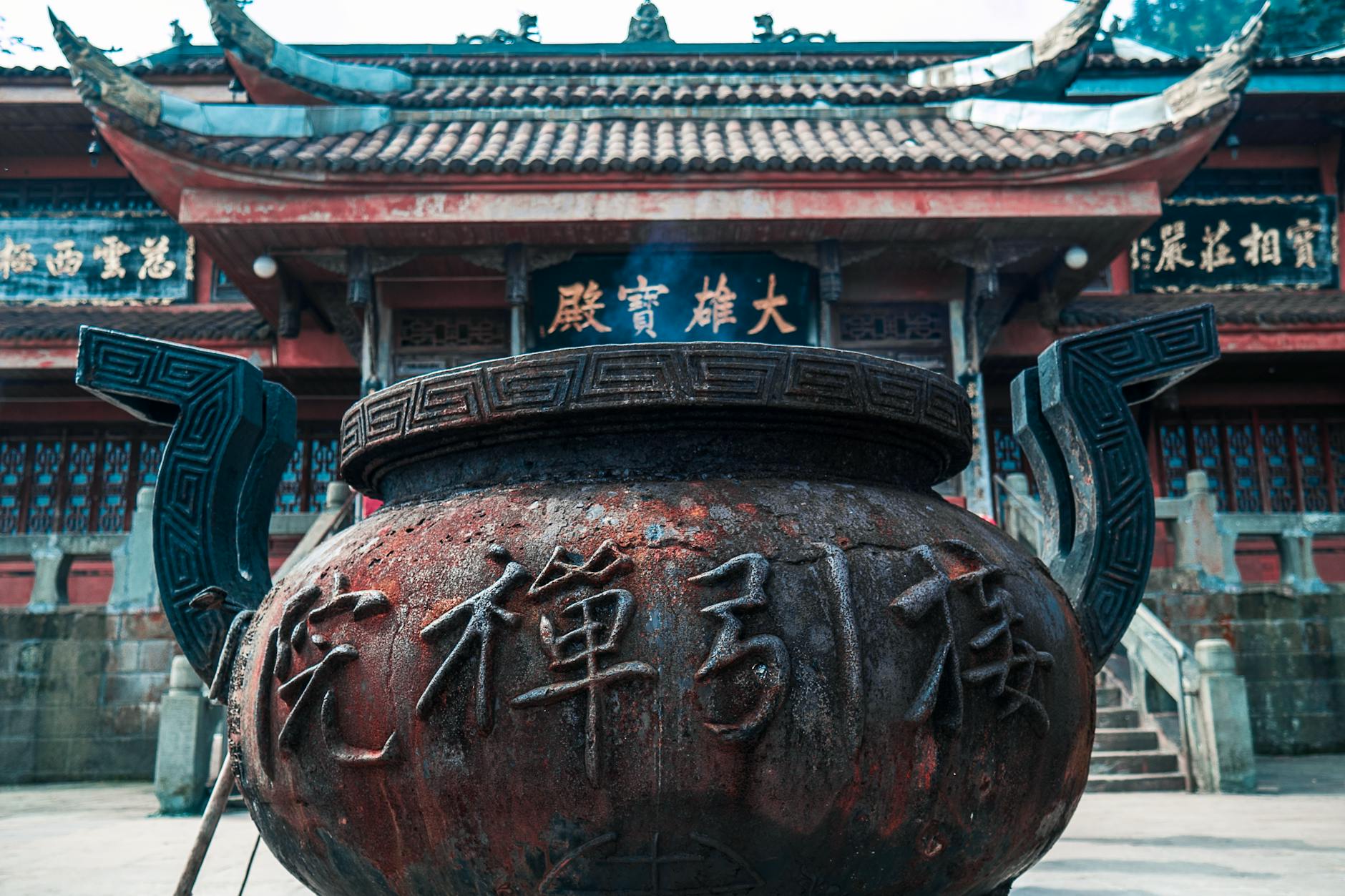
Sichuan is suitable for travel all year round, but the best season depends on the destination. In the basin, spring and autumn (March–May, September–November) are the most comfortable, with mild weather and lush flowers. Summer is hot, but you can escape to the western Sichuan plateau, where the grasslands of Ganzi and Aba are carpeted with wildflowers and the alpine lakes are crystal clear. Winter is the best time for viewing snow‑capped mountains and soaking in hot springs; Jiuzhaigou’s frozen waterfalls and the Hailuogou glacier hot springs are both worth experiencing. Jiuzhaigou in autumn (mid‑to‑late October) has brilliant colourful forests, but it is also the most crowded period, so book tickets in advance.
Must‑do experiences include:
① Giant Panda Homeland—the Chengdu Giant Panda Breeding Research Base or Wolong China Giant Panda Garden. In the early morning, pandas are most active; watching the black‑and‑white balls rolling and eating bamboo is the most healing image of Sichuan.
② World Dual Heritage Pilgrimage—Mount Emei (with its Ten‑Direction Samantabhadra statue on the Golden Summit, sea of clouds, and monkeys) and the Leshan Giant Buddha (view the full statue by boat or hike the Nine‑Bend Plank Road) offer an integration of Buddhist culture and natural wonders.
③ Western Sichuan Plateau Hidden Gems—the waterscapes of Jiuzhaigou and Huanglong are dreamlike; Daocheng Yading is hailed as “the last pure land on the blue planet”; Mount Siguniang is suitable for mountaineering and trekking. Allow ample time for altitude acclimatisation.
④ Exploring Ancient Shu Civilisation—the Sanxingdui Museum and Jinsha Site Museum, where you can see the bronze sacred tree and the Golden Sun Bird gold foil first‑hand, an awe‑inspiring sight.
⑤ Chengdu Slow Life—sit in a tea house listening to yangqin, eat an authentic hotpot, visit Jinli or Wide and Narrow Alleys late at night, and experience the true meaning of bashi (comfortable/easy).
Practical tips: Most food‑delivery apps are available, and mobile payment is widespread, but it is still advisable to carry some cash for street stalls. On the plateau, UV radiation is strong and temperature differences between day and night are large; bring sunscreen and warm clothing. Do not engage in vigorous exercise upon first arriving at high altitude; Rhodiola rosea should be taken in advance. Sichuan cuisine is generally spicy; if you are not used to it, you can order “mild” or choose non‑spicy dishes (such as steamed pork with salted vegetables, sweet steamed pork, or crispy rice with pork slices). Some old‑established restaurants have simple environments, so be mentally prepared.
Special considerations: Photography is not allowed in some Tibetan temple interiors; when turning prayer wheels, go clockwise. Do not feed the giant pandas. The monkeys on Mount Emei are mischievous—do not carry food or plastic bags that may attract them. Summer rains are frequent in the basin, so carry an umbrella. Finally, respect the multi‑ethnic customs and traditions during your travels, and keep a relaxed, open‑minded attitude—then you will truly understand the Sichuanese saying, “Anyi” (carefree and comfortable).